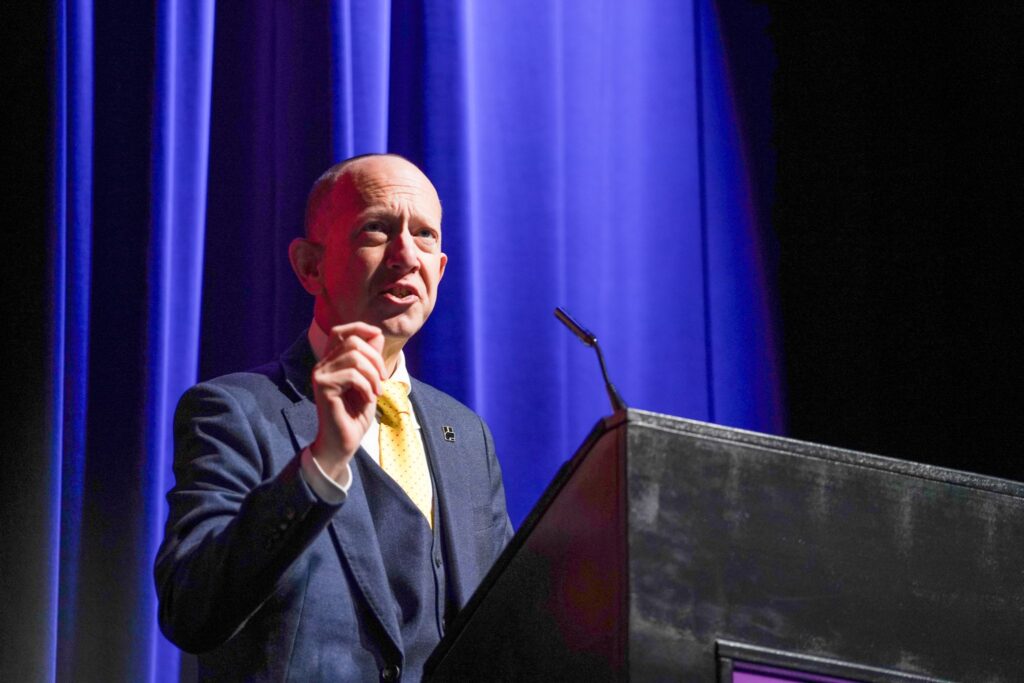
Speaking at yesterday’s UK Screen Investment Summit at BAFTA, Cllr Jeremy Newmark welcomed industry leaders, investors, studio representatives and partners from across the UK screen sector. In his opening address, he reflected on the challenges and opportunities facing the industry, highlighting the importance of skills, investment and devolution in securing the future of UK film and television production.
Cllr Jeremy Newmark
Leader, Hertsmere Borough Council and Vice Chair, Hertfordshire Growth Board
This is the second time I’ve spoken at BAFTA.
Still no statuette. Still no orchestra waiting to play me off. Just five minutes and Katharine with a stopwatch. Which is far more frightening.
On behalf of the Hertfordshire Growth Board, a proud partner of this programme, welcome.
Many of you have heard me at this programme before, so I’ve left the concrete and the postcodes at home. Think of this as the sequel nobody asked for. Like most sequels in this industry, it got made anyway.
Last year we talked about momentum.
This year, the numbers are less kind. Film and high-end TV spend in the first nine months of this year reached £4.1 billion, down a quarter. Inward investment in film is down 40 per cent. Some of that reflects a bumper 2025. Not all of it.
But the cameras haven’t stopped.
Co-production is up by almost a third, and Batman is back shooting in Britain. The world hasn’t stopped choosing Britain. It’s started making us earn it.
Washington has finally noticed where Hollywood goes on holiday.
A bipartisan federal tax credit of up to 30 per cent is moving through Congress to bring production home. And last Friday, America grounded every flight in the country. Officially, a router fault. Unofficially, its most effective production-retention policy yet.
So let me put it plainly:
For a decade, Britain was the destination. Now we are the target.
We won’t win a bidding war with the US Treasury. Congress can match our tax credit with one vote. It can’t legislate a crew into existence.
So at home, three things need fixing.
Skills
On Tuesday, Alan Milburn’s final report landed: a million young people not earning or learning.
Set that beside an industry that can’t find enough crew.
That isn’t two crises. It’s one crisis with a missing bridge.
Last month, 30 Hertsmere teenagers spent a week inside our industry, at Sky Studios Elstree and on location. By Friday, they were screening their own films.
Five days.
I know productions in this room that took longer to agree the catering.
Milburn wants to double the number of young people completing apprenticeships. We want to help. But the system assumes one employer and one long contract.
Our industry runs on freelancers and productions that wrap in weeks.
An apprenticeship that ends when the production wraps isn’t a career path.
It’s a cliffhanger.
So: portable apprenticeships, with the levy moving with the learner from set to set.
An apprenticeship should follow the apprentice, not the payroll.
Business Rates
The 40% studio relief has been a lifeline, and I’m glad the Government kept it.
But it’s a sticking plaster on a structural problem, and it runs out in 2034.
You can’t finance a 30-year studio on a 10-year discount.
David, Pinewood turned 90 this year. Elstree turned 100.
That’s 190 years of filmmaking between us, and still no permanent answer on rates.
We need a lasting settlement that lets investors price the next 30 years, not the next eight.
And as business rates are devolved, let’s build that settlement with places, not for them.
Devolution
Here, I’m an optimist.
Whitehall sets the incentives. Places build the industry.
The West Midlands Mayor has assembled £100 million for the creative industries, including a new Content Production Fund.
Liverpool City Region has its own fund.
The new mayors aren’t just cutting ribbons.
They’re cutting cheques.
In Hertfordshire, we’re moving from 11 councils to less and, we hope, to a Mayor by 2029.
So, as a district council leader, I’m campaigning enthusiastically for fewer district council leaders.
Turkeys and Christmas. It’s complicated.
But we’re not waiting.
Working with Hertfordshire Futures, we’ve approved our own Independent Screen Production Fund.
From Leavesden to Elstree, Hertfordshire is the engine room of British production.
And because no cluster wins alone, our Screen Corridor Agreement with Liverpool makes Borehamwood and the Baltic Triangle two ends of one production line.
And Liverpool is only the first link.
Last year, we talked here about a UK-wide Screen Corridor: one national offer, every cluster plugged in.
This morning, I chaired councils and studios from Northumberland to Bristol, working out how to build it.
One corridor. One country. One offer to the world.
Production runs at the speed of a call sheet.
Devolution is how government learns to keep up.
So, three asks:
- Apprenticeships that travel.
- A permanent fix on business rates.
- Real power in places.
This building exists to celebrate the very best of British screen.
Our job, starting this morning, is to make sure it is still made in Britain.
Share article
LinkedIn Twitter Email