The next Hertfordshire Growth Board Meeting will take place on 14 June and will be livestreamed to enable the public to view. Those wishing to watch the live broadcast should go here where there will be a link to the meeting in due course.
The Agenda and other Papers for the last Hertfordshire Growth Board meeting are available to view using the below link:
To watch the meeting in full, click here.
A blog post by Hertfordshire Growth Board Member – Hertfordshire Local Enterprise Partnership
Hertfordshire Local Enterprise Partnership (LEP), a member of Hertfordshire Growth Board, supports the TCPA’s Healthy Homes Campaign to transform the way the built environment is regulated. Here in Hertfordshire we have seen at first hand how a combination of planning permissions and permitted development has directly resulted in significant losses of employment land. This has had a dramatic impact on the local economy and its implications are far-reaching and, in some cases, irreversible. The erosion of employment space not only impacts on the viability of existing businesses wanting to expand, it also pushes inward investment relocations outside Hertfordshire. For the county to grow sustainably and provide job opportunities for its growing population – a fundamental requisite of Levelling Up – local authorities must be able to plan adequately for employment.
The scale of this problem in Hertfordshire cannot be under-estimated. In 2019, Hertfordshire LEP published a report by Lambert Smith Hampton (LSH) into the Loss of Employment Space. This found that the county had lost significant amounts of employment floorspace over the last decade. In total, there had been a net loss of over 771,000 sq. m. of commercial floorspace countywide over the last decade. That is equivalent to the total office stock in St Albans, Watford and Welwyn Garden City combined. The impact of permitted development rights (PDR) from office to residential conversion will, the study warned, seriously impact the efficient, effective and sustainable operation of town centres as economic growth locations and hinder local authorities from delivering their sustainable place-making agendas.
This repurposing of employment premises to residential via PDR all too often results in sub-standard housing with limited provision for supporting services such as schools, healthcare and civic amenities and little access to green spaces. This is further compounded by councils being prevented from seeking Section 106 contributions to provide or improve local services. It often resulted in the loss of fully viable tenanted businesses, whose landlords saw more profit in conversion to residential flats. Many local planning authorities were so concerned by the extent of the loss of office space that they introduced Article 4 Directions to help control further loss in the future.
Hertfordshire LEP is advocating to Government that securing sustainable communities and economy requires a balanced approach to housing and commercial land/floorspace provision – not just a housing emphasis. With the Hertfordshire population expected to rise by up to 175,000 by 2031, at least 100,000 new homes and jobs will need to be created over the same period. We are also calling on Government to halt PDR conversions, or if this cannot be achieved, to prioritise commercial floorspace in key town centres, allowing automatic exemptions from the PDR that permits conversion of commercial floorspace to residential use.
Hertfordshire’s economy delivers £41.57bn for UK Plc annually (ONS May, 2021). We are home to several globally significant sectors including creative media, film and TV, cell and gene life sciences and advanced manufacturing. These sectors alone have attracted over £4.1bn of new private sector investment in the past 12 months. This surge in investor confidence is helping to super-charge the UK’s recovery. If we want to fully leverage the economic, social and environmental value from this activity, for Hertfordshire and beyond, then we need to ensure there is an appropriate amount, form, quality and distribution of employment floorspace to serve the needs of the Hertfordshire economy and its people.
We endorse this campaign and the TCPA’s Healthy Homes Principles.
Adam Wood,
Head of Infrastructure and Regeneration,
Hertfordshire Local Enterprise Partnership
if you would like to find out more about the campaign visit www.tcpa.org.uk/pages/category/healthy-homes-act or contact Daniel Slade at Daniel.slade@tcpa.org.uk
Six webinars, six highly topical conversations – rewind and review
Over the past 18 months, Hertfordshire Growth Board has delivered a series of lively debates on the key issues affecting the county as it responds and emerges from the pandemic. Businesses, developers, planners and investors tuned in to hear how place leaders, health, education and civic leaders are working together to drive better outcomes for their communities and the local economy. The six sessions covered:
Session 1: Hertfordshire doing things differently
Session 2: Hertfordshire and the economy during COVID-19
Session 3: Hertfordshire Growth Board supporting development and delivery
Session 4: What have we achieved?
Session 5: Making Hertfordshire Investment and Delivery Ready
Session 6: Future Hertfordshire
You can watch the full series again here.

The Hertfordshire Growth Board Webinar Series 2021/22
Missed an episode? Catch up here.
“Great to see the Growth Board coordinating delivery and these events are really good”


Health, education and local government leaders set out their sustainability priorities for 2022 as a part of a live debate on the future of Hertfordshire.
Delegates from across local and central government, the development and construction industry, businesses and civic organisations attended this special hour-long event to hear how Hertfordshire will lead a ‘green’ recovery and help ensure that every person can benefit from good sustainable growth.
Hertfordshire Growth Board is the way the county is now working together to manage growth. With the Hertfordshire population expected to rise by up to 175,000 by the mid-2030s, at least 100,000 new homes and jobs will need to be created over the same period to address those needs.
It is made up of the County Council, the 10 district and borough councils, the NHS Integrated Care System (ICS), Homes England and Hertfordshire Local Enterprise Partnership (LEP).
The event hosted by The Voice of Authority (TVoA) platform and sponsored by Willmott Dixon put a number of questions to its panel of experts and set out to answer:
1. What does sustainable growth actually mean?
2. How are we translating ‘green’ ideas into future ways of living and working?
Cllr Richard Roberts, Leader, Hertfordshire County Council and Chair, Hertfordshire Growth Board, said one of his main priorities for 2022 was to build on COP26 and county commitments to be carbon neutral by 2030.
“Coming out of COVID, we need to work with our residents so that they can live fulfilled and healthy lives. We have to work harder to enable as many people as possible to participate in our vibrant society. The challenge that we also face is that we have to manage future development and our resources more responsibly to reduce our carbon footprint.”
Asked if sustainable development was an oxymoron, Cllr Roberts said moving away from a carbon-heavy agenda, such as providing well-insulated homes and air-source heat pumps, could only be seen as a very positive move.
Cllr Linda Haysey, Leader, East Herts District Council, political lead for the Hertfordshire Climate Change and Sustainability Partnership, set out how the Growth Board is working with this partnership to deliver climate change action and reduce the carbon footprint with policies already in place.
The Hertfordshire Infrastructure and Development Board was also set up, she said, with the primary aim of brokering dialogue between local authorities, investors, developers and land-owners to deliver high quality place-making.
Neil Hayes, CEO, Hertfordshire LEP, set out the work that is underway to develop a clean growth strategy and help the county to achieve its net-zero targets.
The debate then moved to two key areas focusing around health and skills development and why these are so critical to future sustainable growth.
Rt. Hon Prof. Burstow , Independent Chair at Hertfordshire and West Essex Integrated Care System (ICS), said levelling up was a very real issue with a seven year life expectancy gap across the county, and stressed the importance of the ICS working with place leaders via Hertfordshire Growth Board, businesses and education.
He said: “Over the past 19 months we have all been responding to the pandemic and the different waves and that has been a powerful driver for collaboration and innovation. Now as we enter the third year of the pandemic, from a health care perspective we have to restore services and tackle backlogs.
“The health care equation is not about simply delivering better services, it is about addressing those causes of ill health. Seeing healthy lives as a key component of economic prosperity has meant the Integrated Care System has been delighted to become a part of the Growth Board.”
Prof. Julie Newlan MBE, Pro Vice-Chancellor (Business and International Development) University of Hertfordshire, set out the pivotal role universities have to play in driving the local skills agenda and creating opportunities for the future. Hertfordshire was a ‘case study’ in partnership working with strong links between education, industry, business, local government and the LEP to deliver that agenda.
The full series is available to watch again here.
New vocational apprenticeship to help ‘green’ up the industry sector and create a future skills pipeline for sustainable house building
Hertfordshire is to offer a new vocational apprenticeship programme in Timber Frame – MMC (Modern Methods of Construction) thanks to a collaboration between industry and education.
West Herts College is partnering with Stewart Milne Timber Systems (SMTS) as it leads the sustainable challenge, encouraging future workforces to focus on timber frame building solutions.
With around 100,000 new homes needed by 2036, Hertfordshire is committed to scaling up its use of off-site manufacturing (OSM) methods to help speed up housing delivery and meet its net zero carbon targets.
As a leader in off-site, SMTS is working with the Off-site Manufacturing (OSM) Consortium in Hertfordshire, which is led by Watford Community Housing and Hertfordshire Innovation Quarter (Herts IQ) Enterprise Zone, and supported by Hertfordshire Growth Board and Hertfordshire Local Enterprise Partnership, to accelerate delivery and build expertise. This will help drive more affordable housing throughout the region, using MMC and offsite manufactured timber frame.
By partnering with West Herts College, 12 students on the two-year programme will gain a Level 2 Apprenticeship in Timber Frame – MMC while also completing theoretical and practical studies in class. The apprentices will work with SMTS trusted supply chain partners, SE Carpentry and Hyspec Carpentry and Construction.
Having taught carpentry at West Herts College for more than 20 years, this new partnership enhances the curriculum offering, relating the key skills developed and nurtured, and applying this to MMC and timber frame construction.
Gill Worgan, Principal and Chief Executive, West Herts College, said: “We are delighted to be leading the drive for sustainable house building in Hertfordshire by providing the skills so desperately needed for this growing sector to thrive. This partnership is an excellent example of the benefits that can be realised when employers and education providers work together.”
West Herts College director, John McMahon said: “This is an exciting opportunity for students to progress to an apprenticeship with a forward-thinking company like Stewart Milne Timber Systems.
“Students really stand to benefit from this partnership. They will pick up a modern qualification in an expanding sector while working with an industry leader – especially with the added focus of this programme on green, sustainable construction.”
As the timber business’ first apprenticeship scheme, the team hopes to replicate the success of parent company, Stewart Milne Group which now has almost 50 apprentices working across the business.
It is this commitment to apprenticeships and hope of attracting people into the sector that appealed to SMTS, who hope that encouraging young people to work primarily with modern methods of construction (MMC) will not only prepare them for the future, where skills shortages, housing demand and sustainable practices is putting pressure on the sector, but ultimately drive the construction industry’s efforts to tackle climate change.
Simon Horn, technical manager at SMTS said: “Timber frame is still regarded in many regions across the UK as a relatively new solution to the housing crisis. However, it’s a construction discipline that SMTS has long been passionate about, and we’re very excited to be sharing this passion with future workforces.
“Many of our team ‘started on the tools’ as apprentices, and we’re thrilled to now pass on our experiences. This is a great opportunity for young people to get involved, especially at a time when climate change and sustainable building practices is high on the agenda across the UK.”
Adrian Hawkins OBE, Chair, Hertfordshire LEP’s Skills Advisory Panel, said: “This apprenticeship programme will quite literally build the net zero skills needed for the future and support Hertfordshire’s green recovery. The over-arching ambition of our revised Skills and Employment Strategy is to enable Hertfordshire’s key sectors to flourish by developing a skilled workforce that responds to industry needs. By working hand in hand with business and education providers, Hertfordshire LEP can help drive sustainable growth and harness opportunities for all.”
Richard Whitehead, Chair, Herts IQ, said: “With Herts IQ, we’re creating the right conditions for offsite manufacturers and supply chains to innovate, collaborate and thrive in Hertfordshire. Now thanks to this industry collaboration, Hertfordshire is nurturing the skills needed to support a green recovery and deliver a raft of environmentally friendly benefits for residents.”
Patsy Dell, Director of Growth, Hertfordshire Growth Board said: “Hertfordshire is heralding a new era of housebuilding by embracing offsite to help deliver homes at scale to meet our future needs. This partnership will enable Hertfordshire to deliver the construction skills it needs to not only accelerate housing delivery but ensure that it is underpinned by best practice in design and sustainability, creating homes fit for the future that will support generations to come.”
Find out more
The apprenticeship programme will start in February 2022 with places available to book on to now:
A video ‘Partnering with West Herts College on their Apprenticeship Programme’ – is available to view here:


Our vision for the HERT
The HERT will deliver a step-change in the passenger transport network through an accessible, reliable and affordable east-west transit system which connects people easily to where they live, work and visit and will support economic growth, improve the environment and positively impact our existing and new communities. The HERT will connect with north-south rail lines to create new sustainable journey options across the whole of Hertfordshire and beyond.
Where will it go?
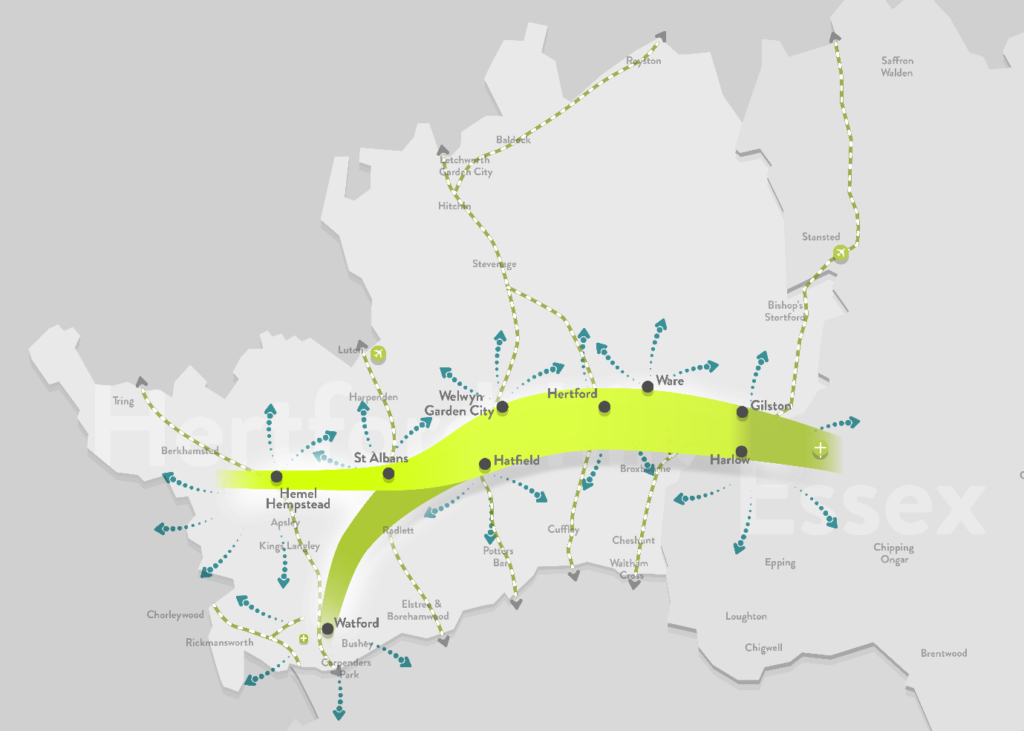
The HERT will form an east-west transport corridor that runs from Watford and Hemel Hempstead in the west to Harlow (Essex) in the east.
The key settlements that will be served by the HERT are connected by the A414 east-west transport corridor, the A405 North Orbital Road and Abbey Rail Line between St Albans and Watford. These transport corridors provide vital local, regional and strategic connections. The corridor will be split into three sections:
- Hemel Hempstead – Gilston this is the main east-west section that will serve the main settlements between Hemel Hempstead and the new Gilston Garden Town. It will also improve connections to Luton Airport via interchange in St Albans.
- St Albans – Watford this north-south section will operate between St Albans and Watford. This corridor is currently served by the Abbey Line with potential for onward connections to west Watford.
- Gilston-Harlow (and onwards to Stansted Airport) will provide links from Gilston Garden Town and into Harlow, providing improved onward connections to Stansted airport via the new bus interchange at Harlow town centre.
It is likely that these sections will be delivered in phases as funding becomes available and in line with planned development.
Why do we need it?
Currently roads in Hertfordshire suffer from traffic congestion due to high levels of car dependency because of a lack of attractive alternative travel options. Over the next 15 years, we will be supporting the District and Borough Councils plan for more than 100,000 new homes and 100,000 new jobs across the county to meet our needs.
A significant number of these homes will be built along this corridor. This means there will be further demand on our already congested road and rail network as more people travel.
What does it mean for Hertfordshire and Essex?
This scheme is an opportunity to reset our ambitions for a new sustainable transport system that crosses urban and rural environments in our diverse county and into west Essex.
It is a chance to think differently and transform our transport infrastructure to one that uses clean energy and provides a real alternative to using private cars – tipping the balance in favour of walking, cycling and passenger transport.
The HERT will help us take one step closer to achieving a cleaner, greener and healthier county.
What are the benefits?
The HERT is being developed to improve Hertfordshire’s transport network in a sustainable way, and to do this, we need to strike the right balance of benefits between our environment, our people and our economy to deliver positive outcomes for our communities.
Some of the benefits include:
- Our Economy: The HERT will make travel easier to access current and future job opportunities and will provide businesses with greater access to skilled people
- Our Environment: The HERT will provide a sustainable alternative to the car, helping to enhance our environment and quality of life through a cleaner, greener transport system
- Our People: The HERT will provide a convenient and competitively priced system that will cater for all ages and abilities in our diverse communities.
Find out more about the benefits the HERT could bring in the virtual exhibition room.
What type of vehicle will it be?
The details around how the HERT will operate, the exact route it will take, and the type of vehicles it will use will be explored through detailed technical studies and further public engagement. Therefore, these elements will not be included as part of this public engagement. Hertfordshire County Council and Essex County Council will work closely to ensure that rapid and seamless journeys can be made across the entire rapid transit network.
Our vision is for a zero-emission vehicle with a modern, comfortable and spacious design that is easy and accessible for all passengers to use.
Have your say on the HERT
We are now analysing your feedback and will share the findings in Spring 2022.
You can still find out more information about our ambitions for the HERT by downloading the HERT brochure from our key documents. If you missed the public engagement period and would like to share your feedback on the HERT, please contact us at HERT@hertfordshire.gov.uk or phone 0300 123 4047.

Making HERT a reality

A project of this scale will take some years to develop and needs substantial investment from local and central government, together with private sector partners. We are in the early stage of developing proposals on the HERT and have a number of steps to go through before it can be built. We will be consulting the public at each stage, with ongoing stakeholder engagement throughout the duration of the scheme.
Get in touch
For enquiries or to request hard-copy materials, contact us at HERT@hertfordshire.gov.uk or phone 0300 123 4047.
The inaugural meeting of the Hertfordshire Infrastructure and Development Board (HIDB) today (11 November) is the latest clear indication that the county means business in its aspiration to deliver the best possible growth for its residents.
A total of 30 organisations have joined the HIDB since a proposal for its formation was approved at a September meeting of the Hertfordshire Growth Board, which established the forum to ensure effective communication and maintain strong relations with the construction and development Industry. This epitomises the collaborative ethos of the Growth Board itself.
With all of those organisations in attendance as the HIDB’s first meeting was held near Welwyn Garden City, it shows that joined-up approach and close engagement between the public sector and development industry was welcome and will be vital in the coming years.
The HIDB brings together the 11 Hertfordshire councils which form the Growth Board as well as Hertfordshire Local Enterprise Partnership, while MPC and Curtin & Co were partners on the formation of the HIDB.
Its primary objective is to enable a beneficial working relationship with the development and construction sector to help to deliver the infrastructure and up to 100,000 new homes that are needed in Hertfordshire by the mid-2030s.
“It is extremely encouraging and pleasing to see that so many in the construction sector have become members of the Infrastructure and Development Board, and that such a large number attended the first meeting today.
Linda Haysey, Chair of the Hertfordshire Infrastructure and Development Board, and also Leader of East Herts District Council and Chair of Hertfordshire Infrastructure and Planning Partnership, said:
“As was shown today, it is also providing a vital channel for engagement and communication with the industry which, as we’ve said before, will make sure matters around growth and development are treated in a really inclusive way for many years to come.”
Richard Roberts, Leader of Hertfordshire County Council and Chair of Hertfordshire Growth Board, said:
“I am delighted that the Growth Board has been able to lead in establishing the Infrastructure and Development Board, which has been formed at such a pivotal time for our county as we aim to deliver the high-quality sustainable growth needed to ensure Hertfordshire is a county fit for the future.
“To achieve this, it is absolutely fundamental to have effective engagement with the construction sector, and the Infrastructure and Development Board will make sure we have that, as well as giving us the opportunity at these meetings to provide feedback from our communities as it is incredibly important that residents feel part of the process.”
It is NOT too late to join the Hertfordshire Infrastructure and Development Board – any organisations in the development sector who are interested in joining the HIDB should email Chris Criscione at chriscriscione@mpc.email or visit the HIDB web page for more information.


Hertfordshire Growth Board is headline sponsor of the 2021 Building Futures Awards – shining the spotlight on new and innovative sustainable development across Hertfordshire.

The Building Futures Awards were launched in 2009 to showcase and celebrate the very best sustainable developments in Hertfordshire and have gone from strength to strength. Hertfordshire Growth Board is delighted to be headline sponsor for the 2021 Awards, which will take place on 21 October 2021 at Knebworth Barns.
There continues to be development pressures in Hertfordshire with a further 100,000 homes needed over the coming years. We need to ensure quality is not sacrificed for quantity and that new development delivers the essential infrastructure to positively grow our communities and be fit for the future, with futureproofing and innovation remaining high on the agenda.
The Building Futures Awards promotes and celebrates schemes across Hertfordshire that are at the forefront of sustainable design and construction. A range of development types and scales are acknowledged, from individual buildings to more holistic large-scale developments which encompass built form and open spaces. Since its inception in 2009, a whole host of organisations and project design teams have had their building and placemaking achievements recognised and celebrated.
Jennifer Owen, Building Futures & Landscape Team Leader for Hertfordshire County Council, explains the exciting changes afoot for the Building Futures Awards 2021. “Launched over 10 years ago, the Building Futures initiative was designed to encourage better building and to strive for better design, placemaking and a greater consideration of the environment.
“Over the years we have seen so many interesting schemes enter the Awards. Building Futures rewards examples of great design, placemaking and sustainability, and indeed sets an example, making a notable contribution to the built form in Hertfordshire.”
The 2021 Awards promises to be the best yet with the addition of a full-day design and placemaking conference to allow important topics to be discussed and covered in more detail.
Here are just some of the projects that have been shortlisted, from left: Osborne Park, Little Heath; Flint House, Watton-at-Stone; Hall Grove, Welwyn Garden City.


Richard Roberts, Chair of Hertfordshire Growth Board and Leader of Hertfordshire County Council, said:
“By supporting the Building Futures Awards, the Hertfordshire Growth Board is demonstrating the importance of delivering the right type of high quality sustainable development to cater for our growing population over the coming years, as well as the infrastructure to support those new homes and places.
“Our ambition is to create a cleaner, greener and healthier county, to nurture and maintain thriving communities in which everyone can learn, work and live well. The creation of the Hertfordshire Infrastructure and Development Board is also vital to this, as we look to work as closely and as effectively as possible with the development and construction industry to make that ambition a reality.”
Patsy Dell, Director of Hertfordshire Growth Board, said:
“We are delighted to be headline sponsors of the 2021 Building Futures Awards. At Hertfordshire Growth Board, we are passionate about responding to the opportunities and challenges that the expected rise in population, homes and jobs across our county brings.
“We are looking forward to seeing the variety of projects and schemes that enter the 2021 Awards, and which will help shape the future of Hertfordshire.”
The awards are open to all projects completed in Hertfordshire between 28 April 2018 and 21 February 2021, regardless of size and sector.
For more information about the awards and to view the shortlist, visit the Building Futures Conference and Awards Hub.


The Hertfordshire Growth Board has moved to ensure effective communication and maintain strong relations with the construction and development Industry with the creation of a new forum for the county.
A proposal for the new Hertfordshire Infrastructure and Development Board (HIDB) was approved at a meeting of the Growth Board on Tuesday (7 September), with its first meeting likely to take place in November.
To enable that approach and close engagement with the development industry, the 11 Hertfordshire councils forming the Growth Board, along with the Local Enterprise Partnership, has chosen MPC and Curtin & Co to be its partners on the formation of the HIDB.
The HIDB will bring together councils and the sector to work on delivering the infrastructure and homes needed in Hertfordshire. A joined-up approach, epitomising the collaborative ethos of the Growth Board itself, with the development and construction sector is seen as vital to delivering the best possible growth – including the building of up to 100,000 new homes needed in Hertfordshire by the mid-2030s.
Linda Haysey, Leader of East Herts District Council and Chair of Hertfordshire Infrastructure and Planning Partnership, has also been appointed Chair of the newly-established Infrastructure and Development Board.
Councillor Haysey said: “The formation of the Hertfordshire Infrastructure and Development Board is further evidence that, in our county, matters around growth and development are treated in a very inclusive manner.
“It means we can and will have a much more co-ordinated approach, as it is very important for borough and district councils – and all of the partners – to have strong relationships with developers, builders and landowners. We are looking forward to working even more closely with developers so we can deliver the type of growth that Hertfordshire expects and deserves.”
Richard Roberts, Leader of Hertfordshire County Council and Chair of Hertfordshire Growth Board, said:
“It is fantastic that the Growth Board is leading the way on making sure that Hertfordshire has effective and beneficial engagement with the development sector. By establishing the Infrastructure and Development Board, it will reinforce and bolster the way we deliver high quality sustainable growth.
“I have no doubt it will be hugely instrumental in helping us to drive innovation in Hertfordshire – to influence the pace of delivery, the quality of development and also enable us to get the type of feedback we need and analyse the issues facing the construction sector. This approach will also be vital in making sure our residents feel engaged and have the opportunity to help to shape plans in their communities.”
Nikki Davies, Managing Director of MPC, said:
“We are delighted to be partnering with Hertfordshire Growth Board to assist in establishing the new Hertfordshire Infrastructure and Development Board. Fostering meaningful dialogue between local authorities, the development industry and key stakeholders in the region is a core business principle for MPC.
“Through digital engagement, analysis and communications management, we are looking forward to helping facilitate important discussions on the positive change that good growth can deliver for communities in Hertfordshire.”
Nick Stanton, Joint Managing Director of Curtin&Co, said:
“Councils in Hertfordshire face great opportunities to secure the infrastructure improvements they know the county needs by working with developers and key stakeholders. At Curtin&Co, we know that honest, open dialogue is key to removing the traditional distrust that surrounds large-scale developments and ensures that communities benefit from strong, local growth.”
Organisations in the development sector who are interested in joining the Hertfordshire Infrastructure & Development Board are being urged to register their interest by contacting Chris Criscione at chriscriscione@mpc.email
Richard Roberts is the Conservative Leader of Hertfordshire County Council and was elected as Chair of Hertfordshire Growth Board on 22 June, 2021.
He was first elected to the County Council in 2003 as the member for Kings Langley and has previously served as the Cabinet Member for Adult Social Care during the Covid-19 Pandemic, Cabinet Member for Public Health, Cabinet Member for Children’s Services and Cabinet Member for Partnerships and Performance. He is Chairman of the Health and Wellbeing Board and became Leader of the Council in May 2021.
Richard is also a Trustee of Community Action Dacorum.
Alongside the delivery of the core services, Richard’s priorities are supporting the county’s recovery from Covid-19; developing the way in which our Health and Social Care system delivers for Hertfordshire; delivering on the commitment to tackle climate change, inspiring our residents to do the same; whilst ensuring responsible and sustainable growth for the county.
Richard is driven by a desire to allow people to live the lives they want to, in the towns and villages residents call home, with the opportunity to learn, work, contribute to society and enjoy Hertfordshire’s beautiful countryside. He recognises that there are concerns for the future around pollution and climate change, jobs and education, good health and wellbeing, and a desire to protect our green spaces, amongst many other issues.
Having achieved a Bachelor’s in Geology from Sheffield University and a Masters in Environmental Studies from Strathclyde, Richard spent 15 years working in the international oil industry before moving to Hertfordshire. He is married with two grown up daughters, and enjoys running, tennis, gardening and walking with his three dogs.